
Web development
Law firm website: what it needs and what it costs
What a law firm website needs (practice areas, fees, bar membership), what EU rules and bar codes require, and what it really costs over three years in 2026.
- Published
- November 24, 2026
- Updated
- November 24, 2026
- Author
- Vitalii Shynkarenko
- ⏱
- 6 min
People looking for a lawyer are rarely in the mood to read, but they want three answers fast: do you handle their kind of matter, what will it cost and how do they reach you. A law firm website has to answer that on the first screen and also follow the e-commerce rules and your bar’s code of conduct.
This guide covers what a law firm website needs, what the rules require, what it costs (with an analysis of what the market offers today) and when you do not need one yet.
The short version
- A law firm website has three jobs: explain which matters you handle, build trust (team, bar membership, how you work) and lead to a first consultation.
- EU rules require regulated professionals to show their professional body and title; bar codes such as Spain’s ban promising results and naming clients without written consent.
- In a November 2026 search, six Spanish offers for law firm websites started at between €350 and €1,200. Four of them do not publish what maintenance costs.
- With us, a site of up to 5 pages costs €500 + VAT; with Basic maintenance it comes to €1,544 + VAT over three years.
- If you work alone, on referrals, with a full diary, a well-kept Google Business Profile may be enough for now.
What a law firm website is for
Many clients find a lawyer through a referral, but before calling they search your name. If they find a 2015 site with a photo of scales, the referral loses weight.
The other half of the job is being found by people who do not know you: someone searching “employment lawyer unfair dismissal” who wants to understand their problem before booking.
So a law firm website is not a brochure. It explains each type of matter, says who will handle it and lets people book a first consultation without hunting for the button.
What a law firm website should include
This is the checklist we go through at the start of a project for a firm. Use it to review your current site or a quote you have been sent:
| Item | Why it matters | Common mistake |
|---|---|---|
| One page per practice area | Each matter is searched with its own words | A single “Services” page listing twenty specialisms |
| Who you work for | Individuals and companies look for different things | “Comprehensive legal advice” without saying for whom |
| Team with names, photos and bar membership | People hire people, not a logo | Stock photos of handshakes in suits |
| How you work and what it costs | It is the doubt that stops the call | Not a hint about fees or the first consultation |
| Tappable phone, WhatsApp and email | Many enquiries come from a phone | The phone number shown as an image |
| A short form | It lowers the barrier to writing | A form that asks for the whole case |
| Legally required details | Mandatory under EU e-commerce rules | No professional body or registration number anywhere |
| Legal notice, privacy and cookies | Mandatory if you collect data | Texts copied from another site with someone else’s name inside |
| Articles or guides | They answer questions and attract searches | A blog with three posts, the last one four years old |
Practice areas: one page each
Someone with an inheritance problem does not search for “full-service firm”. They search “probate lawyer” or “inheriting a house with debts”. If all your areas sit on one page, Google does not know which search to show it for and the client cannot find their case.
One page per area lets you explain which cases you take, how the process usually goes, which documents are needed and who handles it. Five areas plus team and contact will not fit in a 5-page site: group related areas or plan a larger project.
Fees on your website: show them or not
You do not have to publish fees, and for many matters the price depends on the case. But total silence stops the call: clients fear that just asking will cost them.
There are middle grounds: a starting price for routine work (setting up a company, a standard contract) or the price of the first consultation. If you show prices, EU rules require you to say clearly whether they include tax (Directive 2000/31/EC, Art. 5(2)).
The contact form and client confidentiality
A law firm’s form should not ask for the case in detail. Name, contact method, practice area and an optional line are enough; details belong in the meeting. That way you collect less sensitive data by email.
What it does need: a privacy-policy checkbox with a link and a notification that reaches the phone of whoever replies. Our packages include notifications by email, WhatsApp or Telegram.
Lawyer advertising online: what the rules require
A firm’s website is advertising, and legal advertising has its own rules. Across the EU, the E-Commerce Directive 2000/31/EC (opens in a new tab) sets the information every website must show, with extra items for regulated professions. On top of that, each country’s bar has its own code. As an example, we use Spain’s Código Deontológico de la Abogacía Española (opens in a new tab) (2019).
The Spanish code starts from a simple idea: lawyers may advertise freely (Art. 6.1), but advertising must be “objective, truthful and dignified” (Art. 6.2). This table translates each rule into what it means on a website:
| Rule | What it requires | What it means on the site |
|---|---|---|
| EU Directive 2000/31/EC, Art. 5(1) | Name, address, email and VAT number | A legal notice linked from the footer of every page |
| EU Directive 2000/31/EC, Art. 5(1)(f) | Professional body, professional title, Member State where it was granted and the professional rules that apply | In the legal notice and, better still, on each lawyer’s profile |
| EU Directive 2000/31/EC, Art. 5(2) | If you show prices, say whether they include tax | “From €690 + VAT”, not just “from €690” |
| Spain, Código Deontológico, Art. 6.3 | Name your bar in your advertising | The bar visible, not only buried in the legal notice |
| Spain, Código Deontológico, Art. 6.2 d) | Do not promise results that do not depend on you alone | No “we win your case” or “get your money back, guaranteed” |
| Spain, Código Deontológico, Art. 6.2 e) | Do not name clients without their written consent | Client logos, names and cases only with written permission |
| Spain, Código Deontológico, Art. 6.2 a) | Do not reveal facts covered by professional secrecy | Case studies told without anything that identifies anyone |
| Spain, Código Deontológico, Art. 6.9 | No covert advertising | Sponsored or guest articles clearly labelled |
An example: Riera Font, a demo project
To show how we handle all this, we built Riera Font Advocats (opens in a new tab), a demo website for a fictional business law firm in Barcelona. It is not a real client: names and prices are made up. The demo is in Spanish, English and Catalan, and you can try it on your phone.
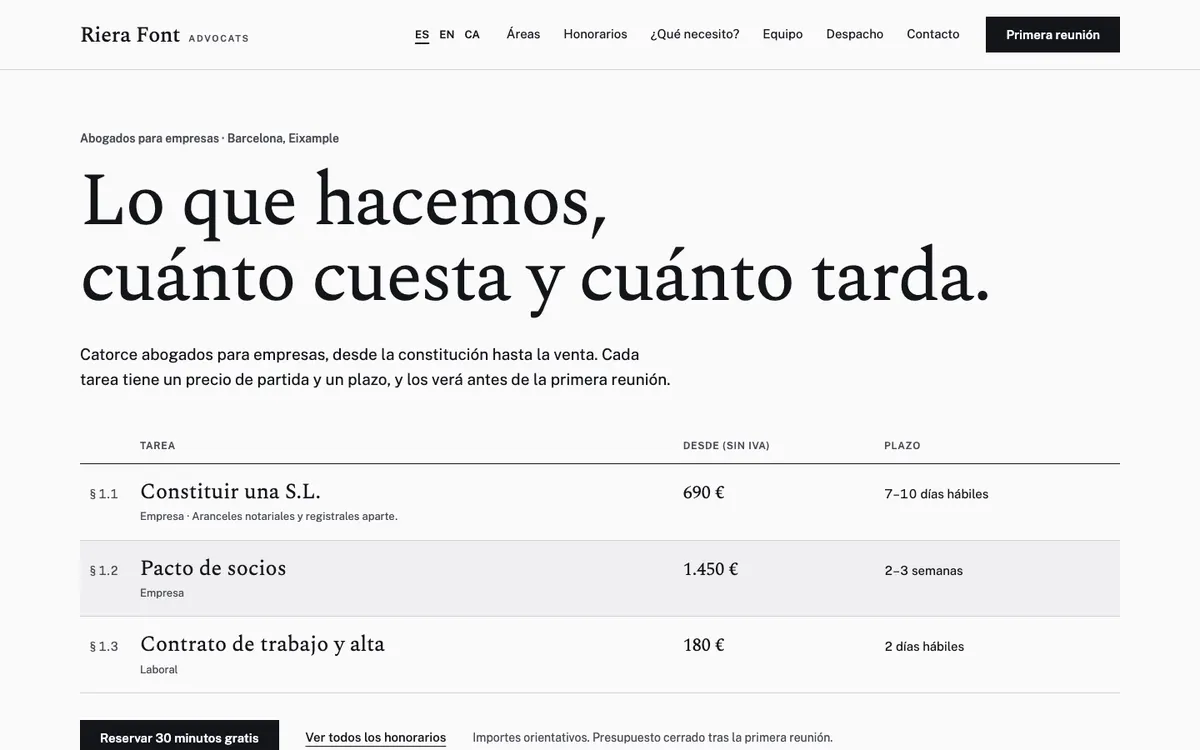
What you will see in the demo:
- The headline answers the three questions: what we do, what it costs and how long it takes. No generic lines about excellence.
- A table of tasks with a starting price and timeline, such as setting up a limited company or a shareholders’ agreement, with a “from (excl. VAT)” column and a note: indicative amounts, fixed quote after the first meeting.
- A “What do I need?” section in the menu for people who do not know which area their problem falls under.
- The first-meeting button always at the top, on the right of the menu.
- Three languages (Spanish, English and Catalan), useful in Barcelona for foreign and local clients.
- A restrained design: a serif typeface, plenty of white space and a single colour. Serious, without scales or Greek columns.
How much a law firm website costs
To see what the market offers, in November 2026 we reviewed six pages from the first results page for “diseño web para abogados” (law firm web design) in Spain, our main market. The data is as each offer publishes it, without names:
| Offer | Starting price | Timeline | Published maintenance |
|---|---|---|---|
| A | €350 + VAT (basic site) | Not published | Not published |
| B | €490 + VAT (first year of maintenance included) | Not published | Hosting extra: €90–295 + VAT/year |
| C | €690 + VAT (WordPress) | Not published | Not published |
| D | €790 + VAT (up to 5 pages) | 7–10 days | From €129/month after the included months |
| E | €900 (VAT not stated) | 4–5 weeks | Not published |
| F | €1,200 + VAT (WordPress) | From 4 weeks | Not published |
| LeetSoft | €500 + VAT (up to 5 pages) | 7 days | €29/month or €79/month + VAT |
Three takeaways. Half do not say how long it takes. Four of six do not publish what maintenance costs, which is what weighs most over time. And at least four use WordPress, two of them with a visual page builder: it works, but the theme and plugins need updating every few months.
Our packages include custom design (no template), a mobile version, a form with notifications, SSL, technical SEO and Google Search Console setup. You see the first design within 48 hours and, if it does not convince you, you pay nothing more. The code is yours from day one. Details are on web development and all prices on pricing.
What you will pay over three years
The starting price says little: what counts is what you pay while the site is live. We compared three years using the figures of the two offers that publish maintenance or hosting prices.
Assumptions: a site of up to 5 pages, 36 months, no major changes. For market offers, only what is published: for offer D, the package of up to 10 pages with a blog (€1,490 + VAT), one month of maintenance included and €129/month after that; for offer B, the site, mid-tier hosting (€135/year) and the domain (€12/year, free in year one), without maintenance in years two and three because it is not published.
| Option | What is included | Three-year total |
|---|---|---|
| LeetSoft: company website + Basic | Site of up to 5 pages, hosting, domain, SSL, backups and small text changes | €1,544 |
| LeetSoft: company website + Full | All of the above plus design changes, new sections and basic monthly SEO | €3,344 |
| Offer D: package with blog + maintenance | Up to 10 pages, blog and maintenance from €129/month | €6,005 |
| Offer B: site + hosting + domain | First year of maintenance; years two and three are not priced | €919 + unpriced maintenance |
The difference lies in the monthly fee, not the starting price. Before signing, ask in writing what maintenance costs, what it includes and whether hosting and the domain are extra.
When you do not need a website
We build websites, so the easy answer would be that you always need one. You do not. You may not need one yet if:
- You work alone, on referrals, with a full diary. A website will not give you more hours.
- Your Google Business Profile is complete: practice areas, hours, phone, real photos and reviews. For a small local practice that can be enough for a while.
- You only work for another firm or an insurer that assigns you matters.
- You will not keep it up to date. A site showing a lawyer who has left or your old address does more harm than no site.
If your Google profile is enough, we will tell you. A website pays off when you want to be found for a type of matter, have several areas or lawyers, or want to filter enquiries before the first meeting.
What to prepare before you order your firm’s website
- Areas and clients
Your practice areas in order of importance, and whether you work for individuals, companies or both.
- The team
Name, role, bar and registration number of each lawyer, a real photo and two lines on their experience.
- How you talk about price
Whether you will publish starting prices, the price of the first consultation or just how you calculate fees.
- Legal details
Company name, VAT number, address and email for the legal notice, and who replies to enquiries from the site.
- Client permissions
If you want to show logos, reviews or cases, written consent from each client.
Frequently asked questions
How much does a law firm website cost?
With us, a one-page landing costs €200 + VAT and a site of up to 5 pages €500 + VAT. In a November 2026 search in Spain, six offers started at between €350 and €1,200. Always ask about maintenance: over three years it can cost more than the site.
Do I have to show my bar registration on my website?
In the EU, yes: Article 5(1)(f) of Directive 2000/31/EC requires regulated professionals to state their professional body, title, the Member State where it was granted and the professional rules that apply. Usually it goes in the legal notice and on each lawyer’s profile.
Can lawyers advertise on their website?
In most EU countries, yes, within the limits of the national bar code. Spain’s code allows advertising freely (Art. 6.1) as long as it is objective, truthful and dignified, names the bar and does not promise results or reveal confidential information.
Can I publish client cases or reviews?
Under Spain’s code, only with written consent (Art. 6.2 e) and without anything covered by professional secrecy; other bars have similar rules. A safe option is to describe the type of matter and how you resolved it, with nothing that identifies the client.
Should I publish my fees?
You do not have to. A starting price for routine work or the price of the first consultation usually encourages people to get in touch. If you show prices, say whether they include VAT (Directive 2000/31/EC, Art. 5(2)).
What if I do not like the design?
We show you a first design within 48 hours. You pay 50 % to start and the rest on delivery. If the first design does not convince you, we refund the deposit (terms in the contract).
Want to know what your firm’s website needs? Tell us on a 15-minute call (opens in a new tab). We will tell you which package fits, or whether your Google profile is enough for now. See also the Riera Font (opens in a new tab) demo, our web development packages and all prices.
More on this on our site: Web development · Pricing.
01 — News
Related news
What web development is and what a real project includes
What web development means, the phases of a real project, what the price should include, and how to choose between a landing page, a company site and a store.
How much does a business website cost in 2026: full price breakdown
How much a website really costs in 2026 — from a landing page to a marketplace, and what affects the final price the most.
02 — Contact
Tell us what you need
We reply with a proposal.