
App development
App development cost in Europe in 2026
App development cost in Europe in 2026: prices by app type and hourly rate, App Store and Google Play fees, maintenance and what you really pay over 3 years.
- Published
- November 25, 2026
- Updated
- November 25, 2026
- Author
- Vitalii Shynkarenko
- ⏱
- 6 min
Look up app development cost and you will find numbers from €6,000 to well over €400,000. Both can be true, which is why neither helps much.
This guide starts from what the top-ranking price guides publish, checks it against Apple’s and Google’s official fees and works out what you actually pay over three years. It also covers when you do not need an app at all.
The short version
- An app’s price is hours times rate. Using a Spanish guide built from real quotes, a simple app takes 200–300 hours: €7,600 – €17,400 with a freelancer and €12,000 – €33,000 with an agency in Barcelona.
- Publishing is cheap: $99 a year for Apple and a one-off $25 for Google Play. The real cost is the store’s cut, around 15% on subscriptions, if you sell digital content in the app.
- The guides agree on maintenance: 10% to 20% of the initial cost every year.
- In our model, a simple €15,000 app costs about €23,550 over three years, plus store fees.
- If what you need is to be found, booked or bought from, start with a website: over three years it costs €1,544 + VAT with us.
App development cost: what the price guides say
In November 2026 we reviewed the guides that rank at the top of Google Spain for “how much does an app cost”. Spain is our main market, and these guides quote local euro rates. Figures as each guide publishes them, without names:
| Guide | Simple app | Timeline for a simple app | Maintenance per year | Where the numbers come from |
|---|---|---|---|---|
| A | €8,000–15,000 | 6–10 weeks | 10–20% of initial cost | Quotes sent by professionals on its platform |
| B | $20,000–60,000 | Up to about 2 months | 15–20% (15–26% in another section) | Not stated |
| C | €6,000–48,000 (MVP, 5–10 screens) | 1–2 months | 15–20%; 25–50% in year one | Not stated |
| D | No prices | Not stated | Not stated | Points to a calculator |
Three takeaways. For a “simple” app the range runs from €6,000 to $60,000, a tenfold spread. Two of the guides use US or Eastern European rates rather than local ones. And only one explains where its numbers come from.
Where they agree is maintenance: 10% to 20% of the initial cost each year. None of them works out how much the store takes in commission over several years, which in the medium term can be the biggest line.
Mobile app development cost: hours times rate
Every serious quote is hours multiplied by a rate. Guide A (Cronoshare (opens in a new tab), August 2026) publishes both for Spain, based on quotes from professionals. In Barcelona a freelancer charges €38–58 an hour and an agency €60–110. It does not say whether VAT is included.
Applying its hours per app type gives this:
| App type | Hours | Freelancer (€38–58/h) | Agency (€60–110/h) |
|---|---|---|---|
| Simple: a few screens, sign-up, content, notifications | 200–300 h | €7,600 – €17,400 | €12,000 – €33,000 |
| Medium: payments, admin panel, integrations | 300–500 h | €11,400 – €29,000 | €18,000 – €55,000 |
| Complex: real time, maps, several user roles | 500–1,000 h | €19,000 – €58,000 | €30,000 – €110,000 |
Hours depend less on the number of screens than on what happens behind them. A payment screen with refunds and invoices weighs more than ten screens of text.
So before comparing quotes, check they all cover the same things: design, backend, admin panel, testing on real phones and store submission.
What pushes the price up
These add the most hours. Anything you can move to version two lowers the quote:
- In-app payments: subscriptions, refunds and invoices.
- Integrations with your CRM, ERP, POS or a poorly documented third-party API.
- Real time: chat, live map tracking or data that changes while you look at it.
- Several user roles: customer, professional and admin, each with its own screens.
- Offline mode with sync later.
- Custom design with animations instead of standard system components.
Native or cross-platform: how much it changes
A native app is written twice: Swift for iPhone and Kotlin for Android. A cross-platform app (React Native or Flutter) is written once for both. That is two codebases to maintain instead of one.
We use React Native by default and go native only when the app really needs it: heavy camera or Bluetooth work, or demanding graphics. For most business apps, cross-platform is enough and cheaper to maintain.
App Store and Google Play fees
Publishing is the cheap part. Apple charges an annual fee of $99 (opens in a new tab) for its developer programme, in local currency where available. Google Play charges a one-off $25 (opens in a new tab) when you register.
What does add up is commission. If you sell digital content or features inside the app (a subscription, a course, game currency), the store takes a share:
| Item | App Store (Apple) | Google Play |
|---|---|---|
| Developer account | $99 a year | $25 one-off |
| Subscriptions (up to $1M revenue a year) | 15% (Small Business Program) | 10% + 5% billing fee in the European Economic Area |
| Other digital purchases in the app | 15% (Small Business Program) | Depends on the programme and when the user installed the app: see the EEA table |
| Physical goods and services (an order, a booking, a ticket) | No commission: charged through your own payment provider | No commission: charged through your own payment provider |
Sources: Apple Small Business Program (opens in a new tab), App Store Review Guidelines (opens in a new tab) (section 3.1.5), Google Play service fees (opens in a new tab) and Google Play conditions in the EEA (opens in a new tab). In the EU there are also alternative terms with different figures; if you will sell digital content, review them before deciding how to charge.
App maintenance cost
An app is not finished the day it reaches the store. Apple and Google ship a new OS version every year, libraries change and users find bugs that testing missed. The guides put this at 10% to 20% of the initial cost per year.
Add the server: guide A quotes €20 to €300 a month for the backend, depending on users and data. An app without maintenance does not break overnight, but one day it stops passing store review or fails on your customers’ new phones.
What you pay over three years: the maths
The launch price tells you little. We modelled a simple app over three years with explicit assumptions, so you can swap in your own.
Assumptions: €15,000 build (inside the guides’ ranges for a simple app); maintenance at 15% a year (the middle of 10–20%); a €50/month server (the low end of guide A); iOS and Android; no major changes; figures excluding VAT.
| Item | Calculation | Three-year total |
|---|---|---|
| Build | One-off | €15,000 |
| Maintenance | 15% of €15,000 × 3 years | €6,750 |
| Server (backend) | €50/month × 36 months | €1,800 |
| Total in euros | €23,550 | |
| Developer accounts | $99 × 3 years + $25 | $322 |
Now say the app sells a subscription bringing in €2,000 a month. At 15% commission the store keeps €300 a month: €10,800 over three years. Almost as much as maintenance and the server combined.
That is why it pays to decide early what you charge inside the app and what you charge outside it.
And if a website is enough
For comparison: a business website of up to 5 pages costs €500 + VAT with us, and with Basic maintenance (€29/month) it comes to €1,544 + VAT over three years. An online shop with the same maintenance, €1,744 + VAT.
They do not do what an app does, but they cover what many businesses actually want from one: being found on Google, taking bookings and selling. A website reaches every customer from a search, without an install.
When you do not need an app
We build apps, so the easy answer would be that one always pays off. It does not. You probably do not need one if:
- Customers use you once or twice a year. Nobody installs an app for a single purchase; a fast website works better.
- You want to be found. Apps do not show up on Google the way websites do. For new customers, start with the website.
- Your idea is not proven yet. Before paying for an app, test demand with a landing page and a form.
- There is no budget to maintain it. Plan for at least 10–20% of the build cost every year. Without it, the app ages fast.
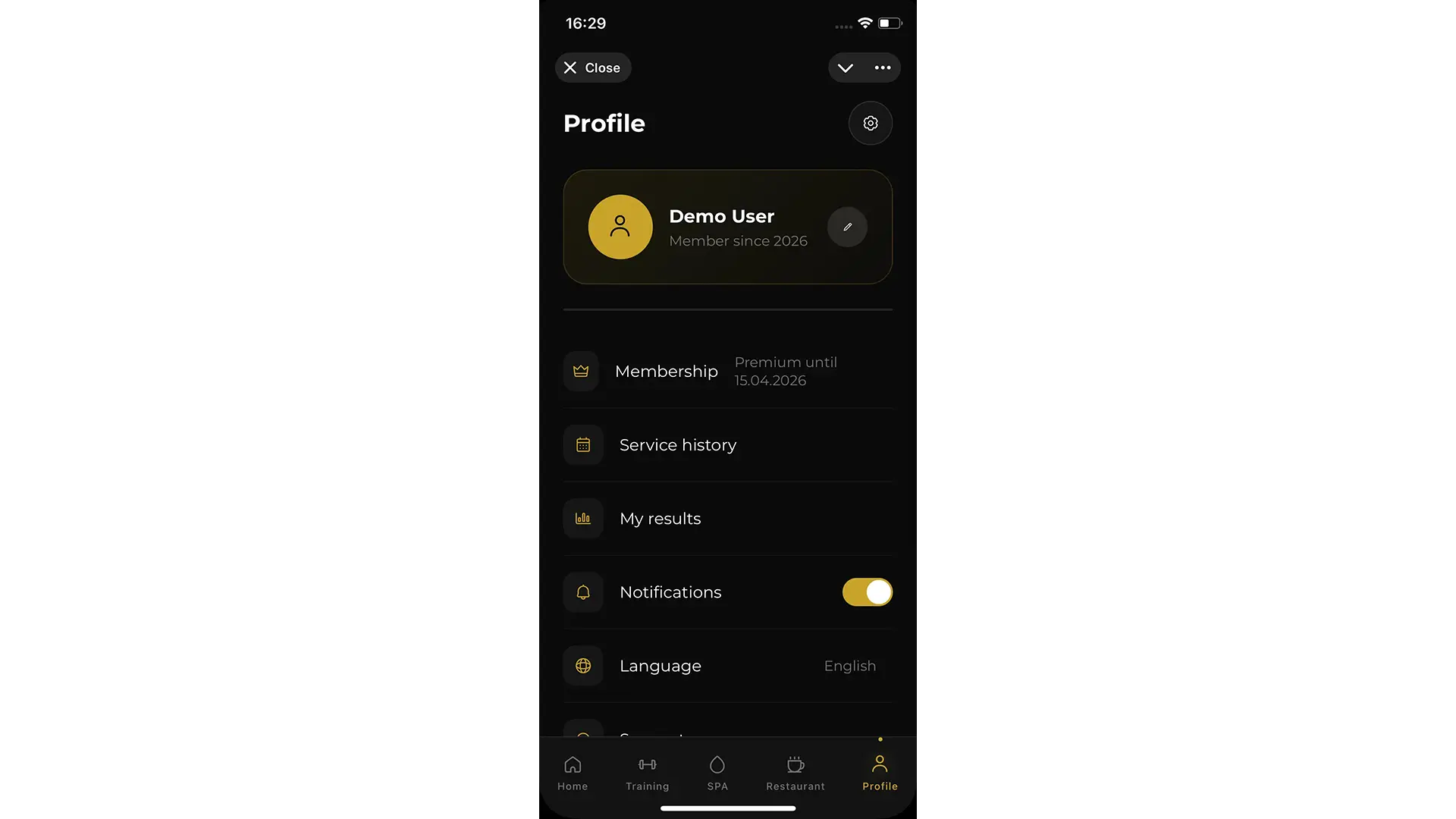
There are middle paths. For the ProFitness gym chain we built a Telegram Mini App: class bookings, bonuses, purchases and QR entry, with no app store involved. It launched in under three months and group class conversion rose by 36%.
An app pays off when customers open it every week: bookings, tracking, loyalty or a product that lives on the phone. That is the case of DreamStep, a fitness app we built that has more than 140,000 registered users.
How to get an app quote without overpaying
- Describe the problem, not a feature list
Who will use the app, what they do today and what should change. That lets the team propose the shortest route.
- Separate what launch really needs
Everything else goes to version two. It is the biggest lever on price.
- List the systems it must connect to
CRM, ERP, POS or payment provider, and whether they have an API.
- Decide how you will charge
Digital content inside the app (with store commission) or products and services outside it (no commission).
- Ask for a fixed price and written scope
Compare quotes by what is included, timeline, maintenance and who owns the code, not by the total alone.
What an app costs with us
We do not publish a “from” price for apps yet: the range is too wide for one number to help you. Instead we give you a fixed quote after a 15-minute call, with scope, price and timeline in writing. The price does not change later, and the code is yours from day one.
If a website or a Telegram Mini App is enough, we will tell you. See how we work in mobile app development and our other prices in pricing.
FAQ
How much does a simple app cost?
Using guide A’s data (August 2026), a simple app takes 200–300 hours: €7,600 – €17,400 with a freelancer and €12,000 – €33,000 with an agency in Barcelona, before maintenance and server costs.
How much does app maintenance cost per year?
The guides we reviewed put it at 10% to 20% of the initial cost each year, plus the server (€20 to €300 a month according to guide A). For a €15,000 app that is €1,500–3,000 a year.
How much does it cost to publish on the App Store and Google Play?
Apple charges $99 a year and Google Play a one-off $25. If you sell subscriptions in the app, a small developer pays around 15% (15% at Apple; 10% plus a 5% billing fee at Google Play in the EEA). Physical goods and services pay no commission.
How long does it take to build an app?
For a simple app the guides say 1–2 months or 6–10 weeks; a medium app, 3–4 months. We launched the ProFitness Telegram Mini App, with bookings, bonuses and purchases, in under three months.
Is a freelancer cheaper than an agency?
Per hour, yes: in Barcelona a freelancer charges €38–58/h and an agency €60–110/h, according to guide A. But an app needs design, backend, testing and store submission; if one freelancer does not cover it all, you end up coordinating several.
How much does an app MVP cost?
An MVP is the smallest version that tests whether the idea works. Guide C puts it at 150–400 hours for 5–10 screens. Sometimes you can test the idea first with a website or a Telegram Mini App, for less.
Want to know what your app would cost, or whether a website is enough for now? Tell us on a 15-minute call (opens in a new tab). See also how we work in mobile app development and all prices.
More on this on our site: Mobile apps · Pricing.
01 — News
Related news
Custom web application development cost in 2026
Custom web application development cost in 2026: price ranges by project type, hourly rates, small business budgets and how to get a fixed quote.
Landing page or business website: which one you need
Landing page or business website (or an online shop): how they differ, which one fits your business, what each costs over 3 years and what EU data shows.
Ready-made SaaS solution or custom development: what to choose for your business
A SaaS subscription or custom development — comparing upfront costs, long-term cost, control over data, and flexibility to help you make the build-vs-buy decision.
02 — Contact
Tell us what you need
We reply with a proposal.