
Web development
Landing page or business website: which one you need
Landing page or business website (or an online shop): how they differ, which one fits your business, what each costs over 3 years and what EU data shows.
- Published
- November 23, 2026
- Updated
- November 23, 2026
- Author
- Vitalii Shynkarenko
- ⏱
- 7 min
Landing page or business website? It is the first question almost everyone who writes to us asks, and sometimes a third option comes up: an online shop. All three are websites, but they do different jobs and cost different amounts, including after launch.
This guide explains the difference, how to choose for your case, what each one costs over three years and when you need none of them.
The short version
- A landing page is a single page with one goal: get the visitor to do one thing (request a quote, book, sign up).
- A business website has several pages: one per service, about you and contact. It lets people find you on Google for each service.
- An online shop makes sense when you will take payments on the site. In the EU, 23.59% of enterprises with 10+ employees made e-commerce sales in 2024 (Eurostat).
- With us: a landing page from €200 + VAT, a business website of up to 5 pages from €500 + VAT, a shop from €700 + VAT.
- If you offer one service in one area and clients come through referrals, a landing page is usually enough to start.
Landing page vs business website: the difference
A landing page is a single page. Everything on it pushes towards one action: a form, a WhatsApp or Telegram button, a booking. No ten-item menu, no blog. Visitors usually arrive from an ad, a social link or a QR code on a business card.
A business website (often called a corporate website) has several linked pages: home, one page per service, about, projects or case studies, and contact. Each page answers a different search. Someone searching for “bathroom renovation in Leeds” lands on the bathrooms page, not the home page.
An online shop adds a catalogue, cart, payment and order handling. It is a business website with a till: products, prices, stock and shipping all need looking after.
All three can share the same design and brand. What changes is the structure and the work they create for you afterwards.
| Landing page | Business website | Online shop | |
|---|---|---|---|
| Pages | 1 | Several (up to 5 in our package) | Home, catalogue, product page, cart, checkout |
| Goal | One specific action | Explain what you do and generate leads | Sell and take payment on the site |
| Where visitors come from | Ads, social, QR codes, direct links | Google (for each service), referrals | Google, ads, social, repeat customers |
| Ranking on Google | One main search | One search per service page | Categories and product pages |
| Upkeep | Minimal | Copy, new projects, blog if you have one | Products, prices, orders, returns |
| Timeline with us | 3 days | 7 days | Up to 10 working days |
| Price with us | €200 + VAT | €500 + VAT | €700 + VAT |
What a landing page is and when to use one
A landing page works when the message fits in a screen and a half: what you offer, for whom, what it costs or how to order, and a button. Typical cases:
- One service in one area: a plumber, a mobile physiotherapist, a school with one course.
- Ad campaigns on Google or Meta. One landing page per campaign converts better than sending the ad to your home page, because visitors find exactly what the ad promised.
- Launches and events: a new product, an open day, a waiting list.
- Testing an idea before investing in a bigger site: if nobody fills in the form, better to know early.
The limit of a landing page is Google. One page can rank well for one main search and its variations, but not for six different services at once. If you do bathroom, kitchen and full renovations, each deserves its own page.
What a business website is and which pages it needs
A business website is your company's full profile online. For a small business, the structure that works best is usually short:
- Home: what you do, for whom, and contact details in view.
- One page per main service: what is included, how you work, guide prices if you can give them, and FAQs.
- About: named people, years in the trade, where you are.
- Projects or case studies: work you have already done, with real photos.
- Contact: form, phone, messenger, address and opening hours.
Five well-made pages cover most service businesses. More pages do not mean more clients; they mean more copy to write and keep up to date. If you later want a blog to answer your clients' questions, it is added to the same site.
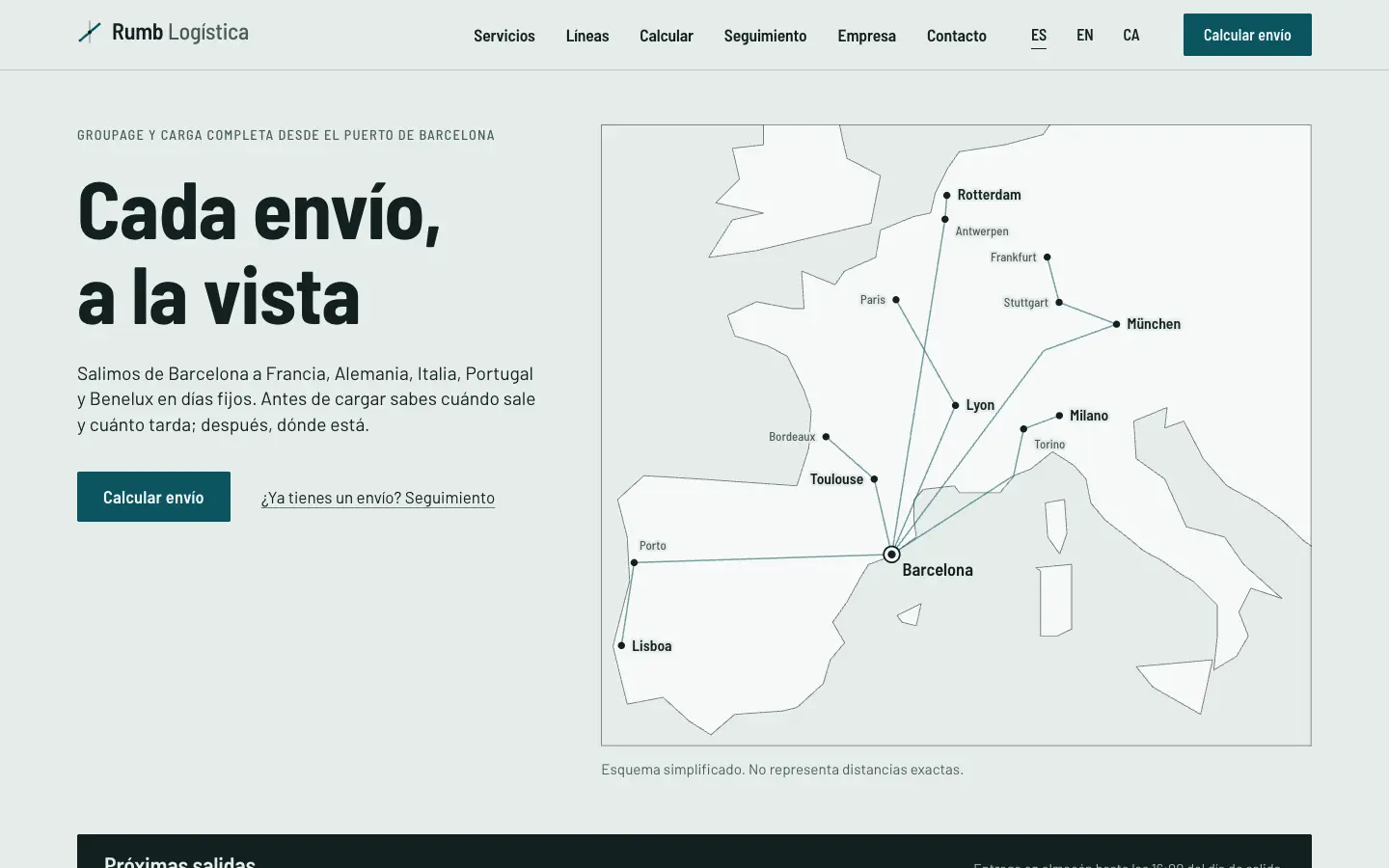
An example: Rumb Logística (opens in a new tab) is a demo project we built for a fictional transport company. It is not a real client, and the site is in Spanish. Its menu has services, routes, a shipping calculator, tracking, company and contact: each section answers a question a client would otherwise ask on the phone. That would not fit on a landing page.
Landing page or online shop: when to sell on the site
An online shop pays off when customers can decide and pay without talking to you: fixed-price products, clear shipping or pick-up, and a catalogue you will maintain. If every sale needs a quote or a visit, a shop saves you nothing; a landing page or business website with a good form is enough.
There are middle grounds. A landing page can have a payment button for one product or a booking with a deposit. A business website can show a catalogue without a cart, with a “request a quote” button. A full shop is for when you will be handling orders every week.
What the data says: how many businesses have a website and sell online
Eurostat surveys EU enterprises with 10 or more employees every year. The latest figures (from Digital economy and society statistics – enterprises (opens in a new tab) and E-commerce statistics (opens in a new tab), data extracted in early 2026) look like this:
| Indicator | Figure | Year |
|---|---|---|
| Enterprises with a website | 79.01% (small 76.66%, large 95.65%) | 2025 |
| Made e-commerce sales | 23.59% | 2024 |
| … only via websites or apps | 17.99% | 2024 |
| … only via EDI | 2.9% | 2024 |
| Share of turnover from e-commerce | 19.49% | 2024 |
| … of which orders via websites or apps | 8.39% | 2024 |
What we read in these numbers:
- For companies with 10+ staff, a website is the norm (79.01%). The question is not whether to have one, but whether yours brings in enquiries.
- Selling online is not the norm: roughly three in four EU enterprises made no e-commerce sales in 2024. A shop is a business decision, not a mandatory next step.
- Most online revenue is not shops: EDI orders between companies (11.07% of turnover) outweigh web and app orders (8.39%).
What each type of website costs over three years
The launch price is only part of it. A website needs hosting, a domain, an SSL certificate, backups and the occasional change. That is why it makes sense to compare what you pay over one and three years.
We did the maths with our prices: package price + monthly support × months. Basic support: €29/month (hosting, domain, SSL, backups and small text changes). Full: €79/month (plus design changes, new sections and basic monthly SEO).
| Website type | Launch price | 1 year with Basic | 3 years with Basic | 3 years with Full |
|---|---|---|---|---|
| Landing page | €200 | €548 | €1,244 | €3,044 |
| Business website (up to 5 pages) | €500 | €848 | €1,544 | €3,344 |
| Online shop (up to 100 products) | €700 | €1,048 | €1,744 | €3,544 |
Assumptions: prices excl. VAT; support is optional and billed monthly; ads, photography, product copy and payment provider fees are not included, as they depend on each provider. If you prefer to host the site yourself, the code is yours from day one and support is not required.
If you compare with a website builder or a shop platform, add up the monthly fee of the plan you need over 36 months, plus the transaction fees listed on its official site.
The difference between types is not only in the table. A shop takes hours every week: uploading products, handling orders, processing returns. A landing page asks almost nothing of you. That time has a cost too.
Landing page or business website: how to decide what your business needs
Answer these questions in order. The first “yes” tells you which type to pick:
- Will you take payments on the site every week?
Fixed-price products, shipping or pick-up, and someone to handle orders. If so: online shop.
- Do you offer several services people search for separately?
Bathroom and kitchen renovations, several specialities, several locations. Each needs its own page to show up on Google: business website.
- Do clients need to get to know you before calling?
B2B sales, expensive projects, trust-heavy sectors (health, legal, property). Team, case studies and process matter: business website.
- Do you have one service or one specific campaign?
One message, one audience, one button: landing page.
- None of the above?
Start with a landing page. If in a few months people ask for more information, we expand it into a business website with the same design.
A few examples of how we would approach it:
- Self-employed electrician in one town: landing page with services listed, service area, a WhatsApp button and Google reviews.
- Law firm with three practice areas: business website with a page per area, named lawyers and contact.
- Winery selling wine: online shop with catalogue and payment, plus a “visit us” page for tastings.
- Company with a website launching a product: keeps its site and adds a landing page for the campaign.
Common mistakes when choosing
These are the ones we see most when reviewing websites that bring in no enquiries:
- Building a 15-page site with no copy to fill it. Empty or repetitive pages do not rank and look abandoned.
- Putting every service on one endless landing page. Visitors cannot find theirs and Google does not know which search to show you for.
- Setting up a shop to sell three products. A payment button or orders via messenger is often enough.
- Sending ads to the home page. Visitors want what the ad promised; if they do not see it in seconds, they leave.
- Choosing on launch price alone. Check the three-year cost and who makes the changes.
When you need none of the three
We build websites, but they are not always the answer. You may not need one yet if:
- All your clients come through referrals and nobody asks for “the website” before hiring you.
- Your Google Business Profile is complete (photos, hours, services, reviews) and that is how people find you.
- You sell on a marketplace that already brings orders and you do not want to run your own shop.
- You will not maintain it. A site with last year's prices or a dead phone number does more harm than having none.
If Wix, Shopify or your Google profile is enough for you, we will say so. A custom site pays off when you want to show up on Google for your services, get direct enquiries and have a design that is yours, not a template shared with a thousand other businesses.
FAQ
Is a landing page a website?
Yes. It is a one-page website with a specific goal. It has its own domain, shows up on Google and can have a form, a messenger button or payments. The difference from a business website is structure, not technology.
Which is better, a landing page or a website?
It depends on how many services you offer and where your clients come from. For one service or a campaign, a landing page. For several services people search for separately on Google, a business website.
How many pages should a business website have?
For a small service business, four to six is usually enough: home, one page per main service, about and contact. Our package includes up to 5 pages.
Can you sell with a landing page?
Yes, if you sell one or a few products: a payment button or a booking with a deposit works on a landing page. For a catalogue with a cart, stock and orders, you need an online shop.
How much does a landing page or a business website cost?
With us, a landing page costs €200 + VAT (3 days) and a business website of up to 5 pages €500 + VAT (7 days). An online shop is €700 + VAT.
Can I start with a landing page and expand later?
Yes. The design and copy are reused and the landing page becomes the home page. Before we start the expansion, we give you the price and timeline in writing.
Not sure whether you need a landing page or a full website? Tell us about your case on a 15-minute call (opens in a new tab) and we will tell you which type fits, or whether you need a website at all right now. You see the first design within 48 hours and, if you do not like it, you pay nothing more. See our web development packages and all prices.
More on this on our site: Web development · Pricing.
01 — News
Related news
What web development is and what a real project includes
What web development means, the phases of a real project, what the price should include, and how to choose between a landing page, a company site and a store.
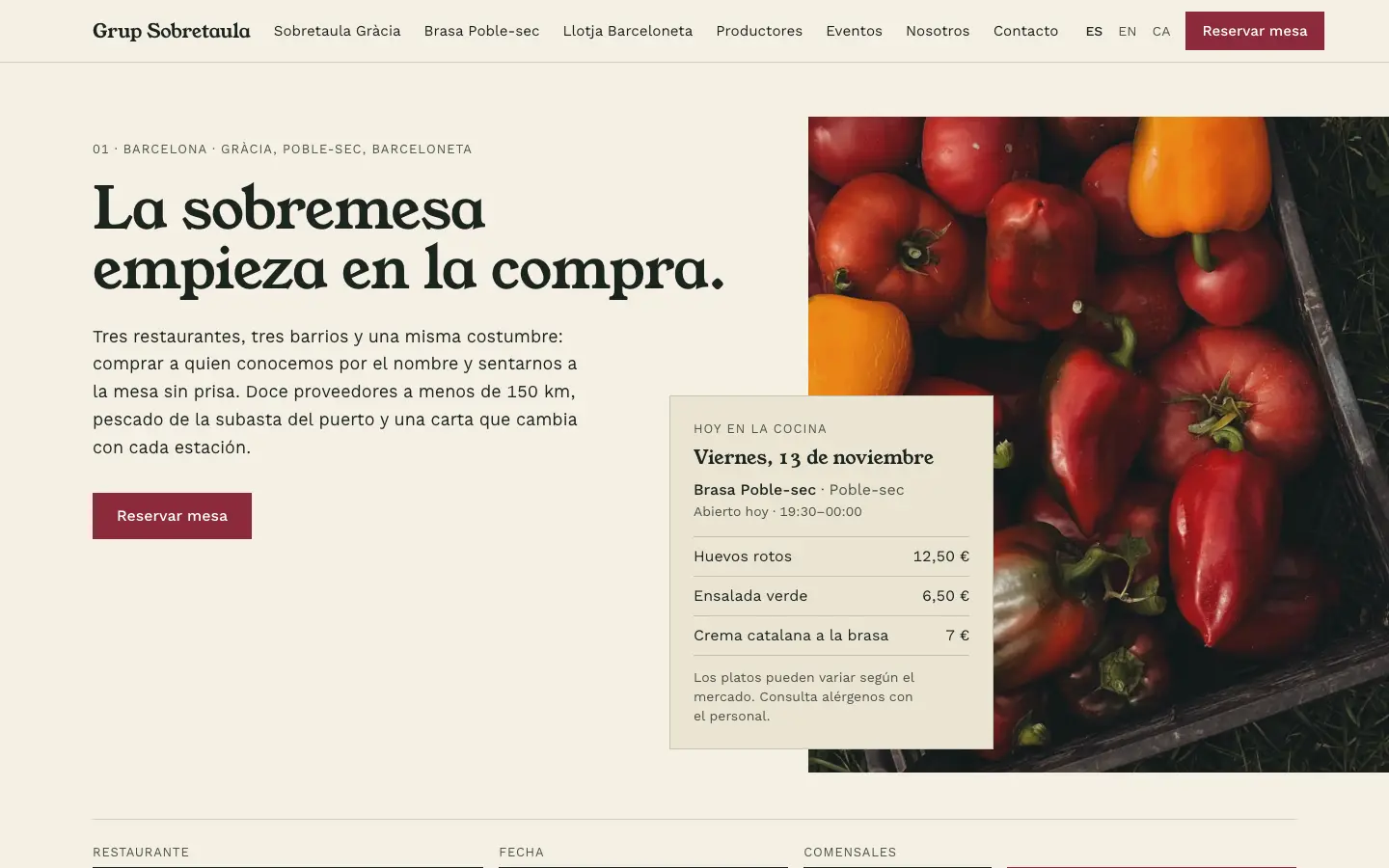
Restaurant website: what it needs and what it costs
What a restaurant website needs (menu, bookings, allergens, opening hours, languages), what it costs in 2026 and when a Google Business Profile is enough.
How much does a business website cost in 2026: full price breakdown
How much a website really costs in 2026 — from a landing page to a marketplace, and what affects the final price the most.
02 — Contact
Tell us what you need
We reply with a proposal.